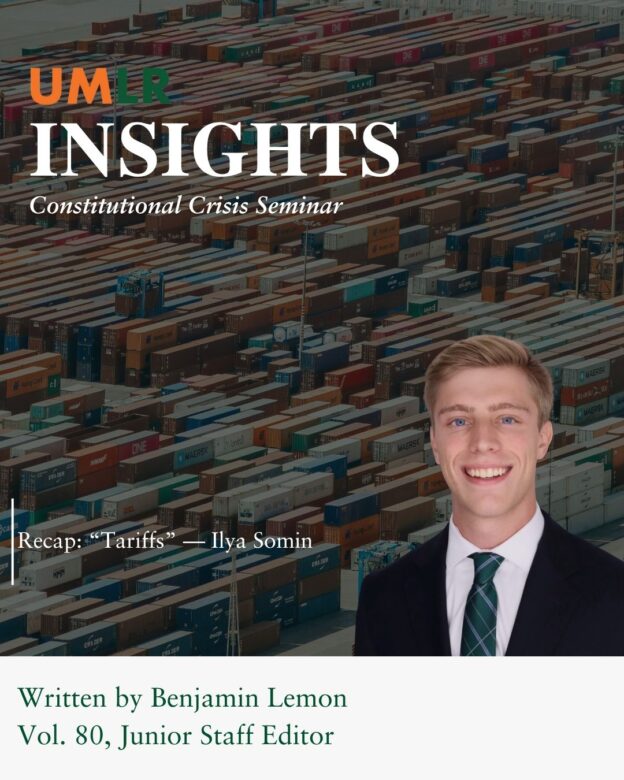
BENJAMIN LEMON—In a wide-ranging lecture and Q&A session, Professor Ilya Somin of George Mason University made his case that the Trump Administration’s recent “emergency” tariffs stretch statutory text past its breaking point, raise profound separation-of-powers concerns, and threaten to normalize delegations that put core taxing decisions in one person’s hands. He discussed what the tariffs are, where the litigation stands (including his own case), and why the asserted authority is unlawful.
Somin’s lecture traced how a sweeping set of “emergency” tariffs rolled out under the International Emergency Economic Powers Act (“IEEPA”) evolved from presidential proclamation to nationwide litigation and ultimately to the Supreme Court. The lecture also featured broader discussions of emergency powers and the rule of law.
The Tariffs at Issue
In April 2025, the Trump Administration announced the “Liberation Day” tariffs, establishing a uniform ten percent duty on most imports, together with additional “reciprocity” tariffs. Shortly thereafter, additional fentanyl-related tariffs were applied to China, Mexico, and Canada. All three measures were implemented unilaterally by executive order under IIEPA, marking the first time the statute had been used to justify tariff actions.
The Current State of Litigation
Somin teamed up with the Liberty Justice Center to represent five small and mid-size U.S. importers. Their suit, V.O.S. Selections, Inc. v. Trump,targets the 10% Liberation Day tariffs and the non-reciprocal “reciprocity” tariffs. They filed in the Court of International Trade (“CIT”) in April, won there, and recently won again in the U.S. Court of Appeals for the Federal Circuit.
A related multistate case, State of Oregon v. Trump, also challenged certain tariffs (including the fentanyl measures), and those, too, were struck down in the CIT and the Federal Circuit. Parallel filings followed nationwide. Some plaintiffs chose the CIT while others went to district courts, prompting a threshold fight over which court has jurisdiction. Most district courts funneled cases back to the CIT, except in Learning Resources, Inc. v. Trump, where the District Court for the District of Columbia kept jurisdiction and held the tariffs unlawful.
The Supreme Court granted certiorari to Somin’s case on an expedited schedule and consolidated the action with State of Oregon v. Trump and, in an unusual move, also with Learning Resources even before D.C. Circuit review. This move signals that the Justices intend to resolve both jurisdiction and merits together in what is likely to be a very impactful decision. Oral arguments are set for November 5th.
The Core Legal Disputes
IEEPA authorizes the President to “regulate” certain international transactions during a national emergency involving an “unusual and extraordinary threat” to U.S. national security, foreign policy, or the economy. But the statute nowhere mentions “tariffs,” “duties,” “impose,” or any synonym for taxation. In Somin’s view, regulating commerce is distinct from levying imposts and duties, both historically and constitutionally. On that reading, IEEPA allows for targeted financial controls in extraordinary circumstances. However, it does not provide a basis for the creation of entirely new tax schedules.
Even if “regulate” were elastic, IEEPA triggers only when there is an “unusual and extraordinary threat.” In Somin’s view, trade deficits and broad industrial trends aren’t unusual or extraordinary, but are instead recurring policy concerns.
Contrary to the Trump Administration’s proposed foreign-affairs carve-out, Somin maintains that the Major Questions Doctrine applies here because tariffs are paid by Americans and have massive domestic consequences. If courts choose to apply the Major Questions Doctrine, the Administration’s tariff program could be viewed as exceeding the bounds of delegated authority, reaffirming the idea that decisions of vast economic and political significance require clear authorization from Congress.
Somin contends that accepting the government’s view would mean there are no meaningful limits on what tariffs the President could impose, for how long, or for what asserted “threat.” That raises the “mother of all nondelegation” problems by effectively transferring Congress’s tariff-setting (taxing) authority to the Executive.
Dissenting judges below have accepted the Trump Administration’s argument that effects on manufacturing and defense could qualify as extraordinary threats. Somin responds that neither the current state of U.S. manufacturing nor the generic notion of trade-deficit reduction is “unusual and extraordinary.” In fact, Somin says the United States has much more manufacturing than it did ten or twenty years ago, and there is nothing unusual or novel about the argument that we need to reduce imports in order to bolster manufacturing.
Why Somin’s Case Matters
The Supreme Court consolidated three leading strands of litigation into Somin’s case. Thus, the suit may be the vehicle for a definitive ruling on whether IEEPA’s text can be read to authorize across-the-board tariffs at all and, if so, whether the Constitution allows such open-ended delegation of taxing power to the Executive during “emergencies.” Given the economic scale and domestic incidence of the duties, Somin frames the dispute as a test of how broadly the word “emergency” can be interpreted and how firm the Court will be about clear congressional statements before permitting policy of this magnitude.
The Rule of Law
The lecture closed on institutional stakes. Somin argued that emergencies should be rare and obvious. If the government must stretch to find an “unusual and extraordinary threat,” courts should be especially vigilant. Beyond doctrine, Somin warns, day-to-day tariff tinkering by the President undermines stability, invites favoritism, and inflicts real-world costs that are difficult to unwind later, even if challengers ultimately win in court.
Somin and the Liberty Justice Center will press the Supreme Court to insist on real limits and real clarity before letting the President rewrite the rules on tariffs in the name of “emergencies.” Somin believes a decision that reaffirms those guardrails strengthens both markets and our Constitution.
Visit the Seminar Main Series Page here.
Watch the episode here.


