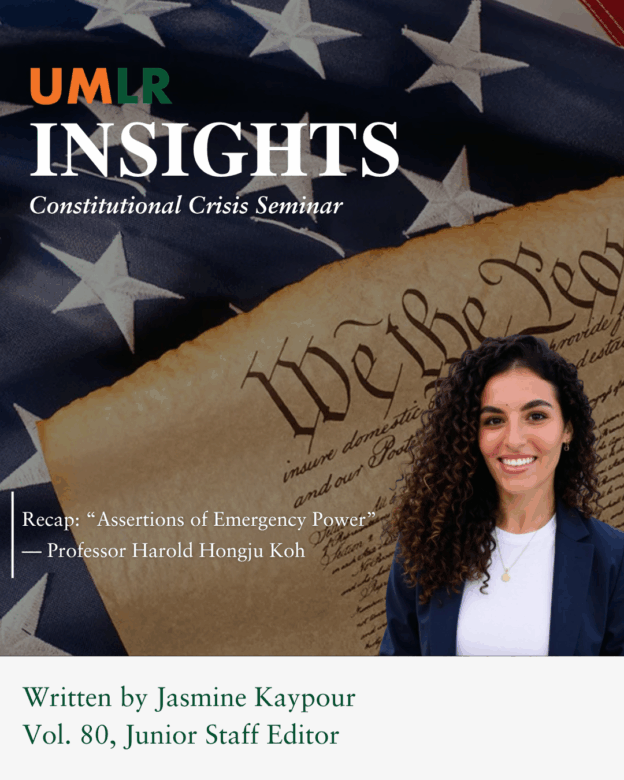
JASMINE KAYPOUR—Harold Hongju Koh, Sterling Professor of International Law at Yale Law School, dissected the state of America’s “National Security Constitution” and the disturbing expansion of presidential emergency powers in his recent lecture. Drawing on history, case law, and recent events, Koh argued that the balance envisioned by the framers—shared power between the president, Congress, and the courts—has eroded into a system where the executive acts unilaterally, Congress stays silent, and the courts defer.
Koh began by contrasting two landmark cases. Youngstown Sheet & Tube Co. v. Sawyer produced Justice Jackson’s influential three-part framework: presidential power is strongest with congressional approval, weakest when acting against Congress, and uncertain—in the “zone of twilight”—when acting without Congress speaking. This vision of shared power stands in sharp contrast to United States v. Curtiss-Wright Export Corp., which described the president as the “sole organ” in foreign affairs. Together, these cases frame two competing constitutional visions: collaboration versus unilateralism. Koh’s thesis is that, in practice, Curtiss-Wright has overtaken the Youngstown framework.
A central example is President Trump’s use of the International Emergency Economic Powers Act (IEEPA) and the National Emergencies Act. With no sudden change in global trade, Trump declared trade deficits an “emergency” and imposed sweeping tariffs. Koh analogized this to walking into Trader Joe’s and trying to sell them a book they do not need—then punishing the store by taxing every customer who shops there. The effect of tariffs, Koh explained, is essentially to impose taxes on Americans: prices rise, consumers buy less, and inflation follows. Employers, uncertain about market stability, stop hiring, leading to weak job reports. After the head of the Bureau of Labor Statistics reported that job numbers were falling, he was promptly fired. The result, Koh warned, is that we now face “emergencies” without the institutional capacity to verify whether they exist, assess their accuracy, or determine when—or if—they will ever end.
The larger point, Koh stressed, is that these emergencies were never genuine in the first place. They were self-created crises—not external, not sudden, not “unusual and extraordinary” as the law requires, and not accompanied by any plan for resolution. Yet once declared, they trigger a vast range of statutory powers. This creates a state of permanent emergency where the president governs without limit.
Congress, in theory, can reclaim authority by defining what constitutes an emergency. But doing so requires majorities in both houses, the certainty of a presidential veto, and supermajorities to override. In today’s polarized climate, lawmakers avoid political risk, leaving control in the hands of the president. What troubles Koh most is not only congressional inaction but also the lack of any attempt to push back. Legislators whose districts suffer from tariffs remain silent, fearful of retaliation from party leadership. The result is a collective action failure and the collapse of meaningful checks.
Koh then turned to the courts, which historically acted as moderators but now increasingly function as “rubber stamps.” This shift moves us away from Justice Jackson’s shared-power framework and toward Curtiss-Wright unilateralism. Recent examples illustrate the danger. To justify aggressive measures against Venezuelan migrants allegedly linked to the gang Tren de Aragua, Trump invoked the Alien Enemies Act—an 18th-century statute once used to support Japanese internment. He labeled the group an “invasion,” treating it as if it were a sudden and extraordinary emergency. However, there was no declaration of war against Venezuela, no declaration of war against Tren de Aragua, and no reliable identification of cartel members. What was really happening, Koh explained, was a shift from a law enforcement paradigm—where smuggling and gang activity are ordinarily handled—into a war paradigm, which unleashed tools of armed conflict without the legal foundation to support them.
The consequences were stark. In one particularly troubling episode, U.S. forces opened fire on a boat of eleven people fleeing toward Venezuela, with no evidence they were members of Tren de Aragua, no proof of imminent threat, no consultation with Congress, and no attempt at capture before resorting to lethal force. While the Alien Enemies Act authorizes detention, it does not, and never has, conferred authority to kill. Yet the administration sought to justify the strike by invoking the Foreign Terrorist Organization (FTO) designation provisions, which only authorize freezing assets—not executing individuals. By stretching these authorities to justify lethal force, the government exceeded any prior practice. Safeguards adopted by Obama and Biden required that capture be attempted if possible, that there be near certainty civilians would not be harmed, and that the target be confirmed as about to launch another attack. None of these conditions were satisfied in the Venezuelan boat incident, raising increased concerns about legality, due process, and accountability.
The judiciary has offered some resistance, as in Trump v. JGG, where Chief Judge Boasberg issued restraining orders to halt deportations of alleged Tren de Aragua members. The administration not only defied the judge’s orders but also accused him of misconduct. By fueling public hostility, it created conditions that encouraged others to intimidate the judge—resulting in incidents like pizzas being sent to his home, a tactic often understood as an implicit death threat. In another case, Vasquez Perdomo v. Noem, courts initially blocked ICE agents from racially profiling Spanish-speaking individuals, but the Supreme Court allowed the practice to continue while litigation proceeded. Justice Sotomayor warned that this created two classes of Fourth Amendment rights: Latinos must carry papers or risk arbitrary detention, while others are spared. Koh summarized the administration’s approach as the “three D’s”: delegalize, detain, deport—often justified under the catchall of emergency.
The consequences are profound. Emergencies have become a political tool, invoked to bypass Congress, intimidate the courts, and undermine constitutional protections. Instead of guarding against real threats, emergency powers are now used to manufacture crises, distort markets, and justify racial profiling and even lethal force. The law envisions emergencies as temporary, extraordinary responses to genuine dangers. But in practice, the executive now wields them as permanent instruments of control.
Koh’s broader warning is that this path leads to the collapse of the “National Security Constitution.” What was designed as a system of shared powers has devolved into executive unilateralism, with Congress paralyzed and courts deferential. Unless Congress sets clearer limits, courts push back, and leaders are held accountable, the U.S. risks sliding into a state of permanent emergency—one where the Constitution’s balance of power is not just strained but undone.
Visit the Seminar Main Series Page here.
Watch the episode here.


