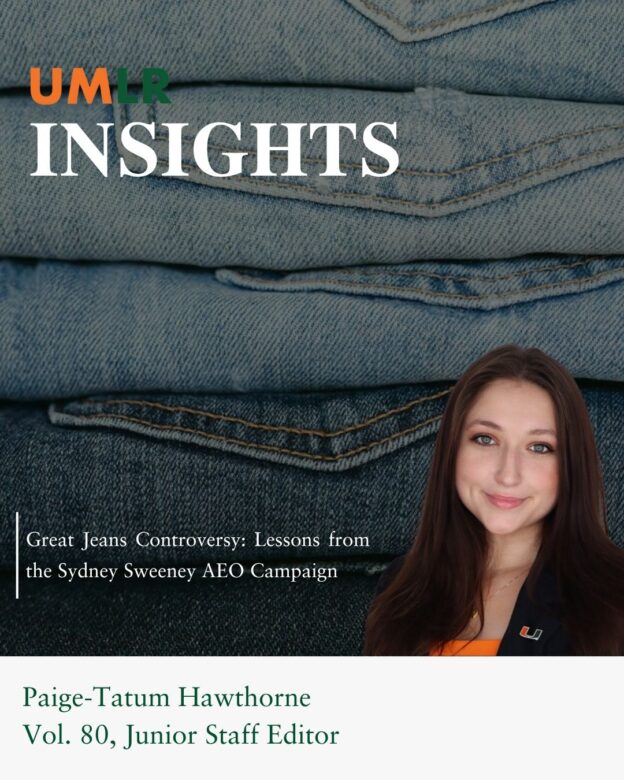
PAIGE-TATUM HAWTHORNE—This past August, American Eagle Outfitters (AEO) launched a campaign featuring actress Sydney Sweeney. In the advertisement, a camera pans Sweeny’s body clothed in AEO jeans, as she suggestively whispers, “Genes are passed down from parents to offspring, often determining traits like hair color, personality, and even eye color. My jeans are blue.” A voiceover then proclaims, “Sydney Sweeney has great jeans.” The campaign ignited outrage across social media and news outlets, as critics condemned its perceived endorsement of eugenics. An extensive list of celebrities, including Dr. Phil, Lizzo, former Bachelorette contestant Gabby Windey, and Doja Cat also criticized the advertisement on various social media platforms. Right-winged political figures such as Senator Ted Cruz and President Donald Trump defended the advertisement. Trump stated “Sydney Sweeney, a registered Republican, has the ‘HOTTEST’ ad out there,” on Truth Social.
Public outrage often serves as a motivator for legal action, especially when a high-profile celebrity, major corporation, shareholders, and the offended public are parties to the issue. While this advertisement caused quite a disturbance and clearly tarnished many people’s perception of AEO and Sweeney, the controversy has not emerged into any legal claims from the public against AEO. This blog post will evaluate whether the law could be implicated at all, evaluating the Sweeney controversy from different perspectives, to highlight the power imbalance between brands and celebrity endorsers caused by contractual control and corporate governance protections.
Of interest is whether Sweeney could successfully sue AEO for reputational damage done by the advertisement. The short answer is probably not. When a celebrity enters an endorsement deal, they effectively license their name and image as property. This tradeoff mirrors employment law: compensation is provided in exchange for reduced autonomy over one’s work product––which, in a celebrity endorsement deal, is their image. This means that the employer’s contract “dictates what you do, how you present yourself and sometimes even what you can say on your own time.” Just as an employee’s work belongs to the employer, a celebrity’s image, once licensed, belongs to the brand for the agreed scope of use. Thus, the company can use that image in accordance with the contract, and the celebrity bears the risk of public reaction.
This, however, differs from cases where a company uses a celebrity’s image without authorization. In such scenarios, courts have consistently found liability since unauthorized use violates the Right of Publicity or misleads consumers into believing the celebrity endorsed the product. Although, it is important to note that the specifics of the Right vary depending on the state. In contrast, Sweeney’s contract with AEO gave the company permission to use her image. Whether she approved the creative content, or AEO exercised contractual control, she bears the risk of negative reputational consequences because the company acted within its rights as outlined in the contract.
Of further interest is whether AEO could successfully sue Sweeney if she spoke out negatively against the company after the advertisement went public. The answer to that question is possibly. Moreover, there may be a First Amendment issue to consider. The First Amendment only restricts government action, not private companies. However, when a celebrity does work for a private company, such as participating in a marketing campaign, the company can limit public statements about its products, campaigns, or brand. In fact, endorsement agreements typically include non-disparagement clauses prohibiting remarks that could harm the company’s reputation or undermine the campaign’s messaging. Thus, if Sweeney publicly disagreed with the advertisement, AEO could argue that Sweeney breached her contract if reputational or financial harm occurred in reaction to her speaking out. Success of the claim would ultimately depend on the clause’s scope, whether her statements are truly disparaging, and whether actual damages exist.
Moreover, endorsement contracts often include morality clauses, allowing the brand to terminate the agreement or seek damages if a celebrity engages in conduct that could harm the company. Typically, however, simply disagreeing without revealing proprietary information would likely not constitute a violation of a morality clause nor a confidentiality clause. In practice, disputes are usually resolved through negotiation rather than litigation. In response to the backlash over the Sweeney advertisement, AEO’s Chief Executive Officer, Jay Schottenstein, instructed executives to remain calm and not comment publicly. Additionally, Sweeney refused to discuss the controversy at a film festival. These choices reflect strategic efforts to manage reputational risk without escalating legal disputes.
In turning to AEO itself, it is possible for internal claims to arise if fiduciary duties were breached by the company’s directors and officers in the making of the advertisement. General corporate law maintains that directors and officers must act with care, loyalty, and good faith. Moreover, decisions made in good faith with reasonable inquiry are protected by the Business Judgment Rule, even if outcomes are unpopular. In addition, the law does not require corporate decisions to be objectively right––only reasonable and made without self-interest. Here, Schottenstein personally approved the campaign, instructed executives to monitor outcomes, and oversaw internal coordination. With no apparent evidence of gross negligence or bad faith, the potential of internal claims are weak and unlikely. In fact, despite public outrage, the campaign actually achieved measurable success, including rising stock value and record customer acquisition.
This power imbalance between celebrities and companies, may become even riskier, as Artificial Intelligence (“AI”) can fabricate actions and statements a celebrity never said. AI use may be allowed under contracts if the company has control over the celebrity’s image and the product generated is within the scope of what was agreed on. Additionally, contracts are often intentionally broad on new technologies. However, explicit clauses may be added––or even required––when using AI, further impacting a celebrity’s power and possibility of reputational damage.
Overall, while no legal claims have officially emerged, the controversy of the Sweeney advertisement highlights deeper issues about control, autonomy, and accountability in celebrity endorsements. Once signed, celebrities lose substantial control over how their image and persona are used. In endorsement agreements, a celebrity’s likeness and image often become company property. Companies can impose an array of restrictions beyond the campaign which dictates a celebrity’s behavior, public statements, product usage, and appearances. This grants such companies broad discretion in shaping a celebrity’s public perception. Given the nature of endorsement deals, which often include numerous restrictive clauses, celebrities have limited freedom when participating in campaigns. Additionally, proving tangible harm in litigation involving reputational damage is difficult, especially for celebrities.
Thus, celebrities have little freedom and ability to protect themselves when a campaign goes sour and impacts their public perception. This power imbalance is exacerbated by internal governance protections that shield corporations from liability, unless their actions involve bad faith, fraud, self-dealing, or gross negligence. These dynamics, which will become greater with the use of AI, underscore why contractual control and the power imbalance between brands and celebrity endorsers is an area deserving more attention. Sweeney’s genes show there is far more at stake than meets the eye.


