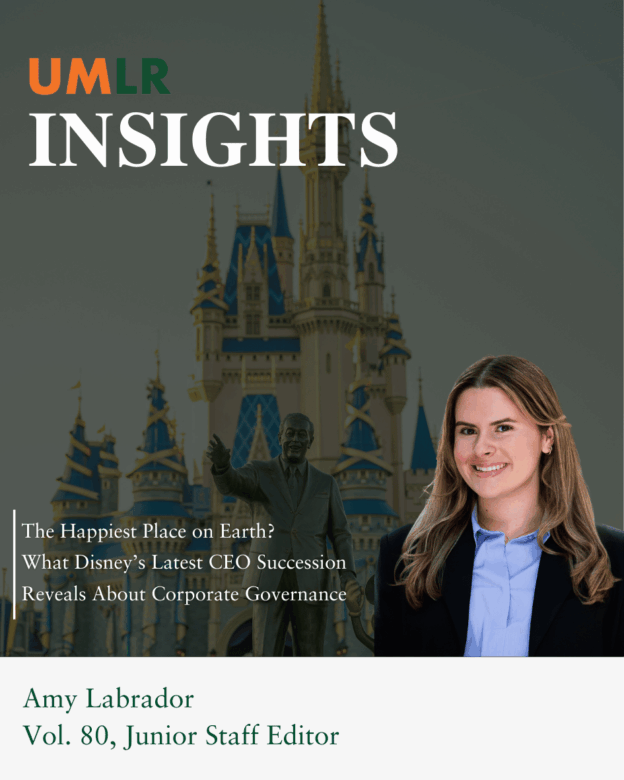
AMY LABRADOR—The Happiest Place on Earth made an exciting announcement on February 3. The Walt Disney Company Board of Directors elected a new Chief Executive Officer, Josh D-Amaro, to replace longtime CEO Robert A. Iger, who has led Disney for almost two decades. Iger will remain at Disney, serving as senior advisor until he retires on December 31, 2026.
Yet this is not the first time Iger has planned a retirement from Disney, and the last time he stepped down was characterized as a disaster. Back in February of 2020, after delaying his retirement four times, Iger transitioned away from being CEO to allow Bob Chapek––who was, at the time, Disney’s parks chairman––to take over the coveted position. Chapek became CEO just before the COVID-19 pandemic, and his time in the role soon became marked by significant instability.
For example, Chapek’s response to Florida’s Parental Rights in Education Act was widely viewed as mismanaged. Chapek initially chose not to take a public position, explaining that corporate statements rarely change policy outcomes and can be counterproductive. After significant backlash from employees, he pivoted and publicly opposed the bill. Florida lawmakers responded by dismantling Disney’s long-standing special district governance structure, removing a framework that had given the company considerable control over taxation, zoning, and infrastructure development.
Although the Board extended Chapek’s contract for three years in June 2022, Disney’s stock had fallen more than 40 percent that year, and activist investors were openly demanding significant changes. By November 2022, Disney disclosed that its streaming services had lost nearly $1.5 billion during the July through September quarter. Within five months of renewing Chapek’s contract, the Board reversed course and abruptly reinstated Iger in November of 2022.
The retirement and reinstatement of Iger raises questions about whether the Board fully owned the succession process or deferred too heavily to the outgoing CEO’s influence. In 2017, Iger informed Chapek that he was a potential successor, and a formal vetting process involving one-on-one meetings with directors was considered. However, after Disney’s $71 billion acquisition of Fox, Iger renewed his contract and succession discussions were delayed. When the transition resumed in January 2020, the appointment process was streamlined. Rather than conducting individual director interviews, the Board approved Chapek following Iger’s recommendation.
Disney’s 2026 CEO succession planning reflected a more deliberate and structured process. Disney’s Board formed a dedicated succession planning committee and placed the search under the leadership of an independent board chairman. Over the course of multiple fiscal years, the committee met regularly and evaluated a broad slate of internal and external candidates, defining the attributes needed in the next CEO before making a selection. Internal candidates were developed and mentored, and D’Amaro’s appointment appears to have resulted from a competitive evaluation rather than a single recommendation.
CEO succession planning is widely recognized as one of a board’s most important oversight responsibilities. Regardless of a current CEO’s performance, boards are expected to maintain a thoughtful and ongoing plan for leadership transition. That process includes identifying internal and external candidates and regularly evaluating whether the company’s future strategic needs align with the skill sets of potential successors. This is not merely a matter of best practices. Directors owe duties of care and loyalty to their corporation, which require informed, independent decision-making in the best interests of the corporation. Succession planning, as a core component of board oversight, falls squarely within those duties.
Courts, however, evaluate board directors’ decisions under the business judgment rule, which is highly deferential and presumes that directors acted on an informed basis, in good faith, and in the belief that their decision was in the corporation’s best interests. Courts do not second-guess outcomes simply because they prove unpopular or unsuccessful.
That deference, however, is not absolute. It gives way when directors are materially conflicted or act in their own self-interest. Self-interest in the succession context would look very different from what occurred at Disney in 2022. Merely deferring too heavily to a former CEO’s preferences is not enough to sustain a self-dealing claim. A viable claim would require evidence that directors acted for personal benefit rather than for the corporation’s interests. For example, self-dealing might arise if a director supported the return of Iger in exchange for retaining a board seat, receiving enhanced compensation, or protecting a related business interest. It could also occur if a returning “boomerang” CEO, such as Iger, negotiated compensation or contractual protections that disproportionately benefited him, and the board approved those terms without meaningful independent review. In those circumstances, the decision would resemble a conflicted transaction rather than a protected business judgment.
In Disney’s case, however, there is no indication that either Chapek’s appointment in 2020 or Iger’s reinstatement in 2022 involved personal enrichment or improper conflicts. The available record suggests that the Board’s decisions were grounded in its assessment of the company’s strategic and financial circumstances, not in self-interest. As such, both leadership decisions most likely remain within the protection of the highly deferential business judgment rule.
The contrast between Disney’s 2020 and 2026 succession efforts ultimately underscores a broader governance lesson. Corporate law does not demand perfect outcomes from boards. Courts will not impose liability merely because the board selected a successor who later underperformed or caused a decline in stock price. The business judgment rule reflects that reality by protecting decisions made in good faith, even when those decisions prove controversial or unsuccessful.
Whether D’Amaro ultimately succeeds as Disney’s next CEO is a business question that only time will answer. From a governance perspective, however, the more deliberate and structured process signals a Board that has learned from its earlier missteps and has reasserted its central role in one of its most important fiduciary responsibilities.


