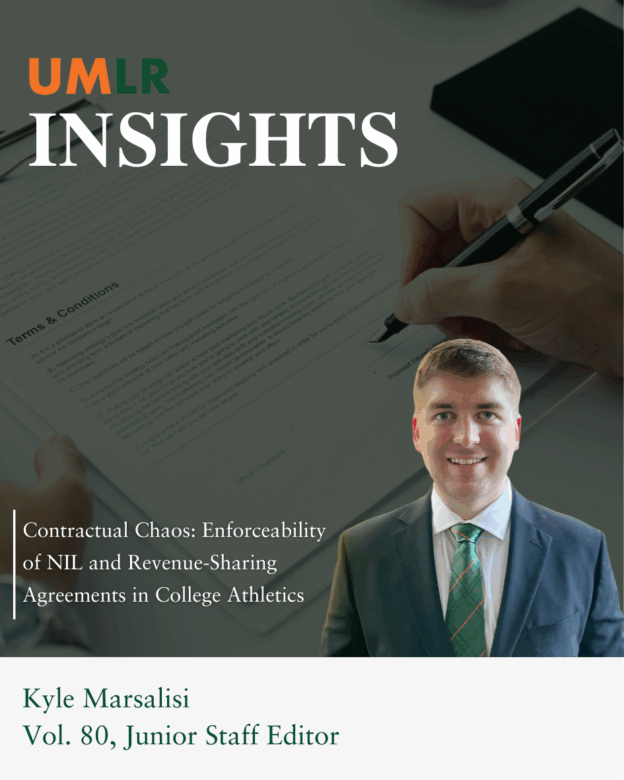
KYLE MARSALISI—For nearly all of its history, the National Collegiate Athletic Association (NCAA) has prohibited student-athletes from receiving compensation for their participation in collegiate athletics. While colleges and universities have profited off their athletic programs for years, the ability for students to benefit from their contributions is a fairly new advent. In 2021, student-athletes first began to profit from their name, image, and likeness (“NIL”), following changes in both state laws and NCAA rules. However, institutions were not permitted to pay student-athletes directly until June 2025, when a District Court judge approved an antitrust settlement between Division I student-athletes, the NCAA, and its coordinate “Power Four” member conferences, including the Big Ten Conference, Big 12 Conference, Southeastern Conference, and Atlantic Coast Conference. Pursuant to the terms of the colloquially-termed “House Settlement,” the NCAA agreed to pay more than $2.8 billion in back damages to student-athletes who participated in collegiate athletics between 2016 and 2024. Additionally, the NCAA approved a forward-looking revenue-sharing structure, whereby each Power Four school is permitted to distribute athletic revenue to student-athletes up to 22% of its annual “average shared revenue.” While the monetary cap will increase each year, institutions were given the discretion to distribute up to $20.5 million for the first academic year of 2025-2026.
The settlement came as a large victory for student-athletes, but it has since raised a number of legal questions that have yet to be answered. Principally among those is whether and how contractual agreements between universities and student-athletes will be enforced. That question came to the forefront of public debate upon the conclusion of the 2025 football season when a dispute arose between the University of Washington and its star quarterback Demond Williams Jr. Just days after Williams signed a revenue-sharing contract, reportedly worth more than $4 million, to return to Washington for his junior year, he informed the university of his intent to transfer schools. However, just days after, Williams revealed that he would return to Washington for the 2026 season after the University informed him that it would not allow him to enter the transfer portal and threatened legal action to enforce the contract. The NCAA transfer portal is an online database that student-athletes enter when they decide to change schools, enabling coaches to easily identify and begin recruiting available student-athletes. In order to enter the portal, student-athletes who play football have a thirty-day window following the end of their regular season to notify their current school of their intent to transfer, at which point the school must enter their name into the portal within two days. Though the portal was designed to promote efficient transfers and empower student-athletes to seek greater opportunities, it has evolved into a system of perpetual unrestricted free agency. And while Williams and Washington ultimately resolved their differences amicably, the situation highlighted the need for clarity around the enforceability of both NIL and revenue-sharing contracts in the wake of the House Settlement.
The dispute between Williams and Washington is not the first of its kind, and it certainly will not be the last. In fact, the clash nearly mirrors a dispute that arose following the 2024 college football season, when University of Wisconsin freshman defensive back Xavier Lucas decided to transfer to the University of Miami after entering into a revenue-sharing agreement with Wisconsin. That agreement was set to provide Lucas with one of the largest revenue shares on the Wisconsin team for 2025 and required his pledged commitment to the University for two years. That deal did not, however, end as harmoniously as Williams’ deal with Washington. When Wisconsin sought to enforce the contract by refusing to facilitate his transfer, Lucas hired renowned NIL attorney Darren Heitner to negotiate a resolution before Lucas simply withdrew from the university and enrolled at Miami—marking the first time a student-athlete successfully avoided the transfer portal. While Wisconsin ultimately did not pursue legal action against Lucas, it did file suit against Miami for tortious interference in June 2025.
These disputes similarly parallel two pending lawsuits that could provide much needed clarity in this emerging area of contract law. The first is a suit between the University of Georgia and Damon Wilson II, who transferred to the University of Missouri following the 2024 college football season. Wilson signed a NIL deal with Georgia in 2024, committing himself to the University for at least the 2025 season, before deciding to enter the portal and transfer to Missouri. However, rather than pursuing legal action against Missouri, as Wisconsin did against Miami, Georgia sued Wilson directly in 2025, claiming he owed them $390,000 in liquidated damages. While it has become commonplace for schools to insert liquidated damages clauses in their revenue-sharing contracts with student-athletes, some legal experts claim that schools are inappropriately using them as a “buy out fee” to punish players who transfer. Because liquidated damages must be tied to actual damages, it stands to see whether such clauses may actually be used by schools to enforce these agreements.
The second suit was brought by Duke University against its start quarterback Darian Mensah, who informed Duke of his intent to transfer on January 16, 2026, the day the transfer portal closed. In 2024, Mensah transferred to Duke from Tulane University and signed a two-year NIL agreement through the 2026 season, worth a reported $7.5 million. On January 19, 2026, Duke sought a temporary restraining order (“TRO”) to prevent Mensah from entering the transfer portal and block him from signing a new deal with another school. On January 20, 2026, a Durham County (NC) Superior Court judge denied Duke’s TRO request, permitting Mensah to enter the portal. However, according to Mensah’s attorney, Darren Heitner, the quarterback will not be permitted to enroll or play football at another school before the resolution of an injunction hearing that is currently scheduled for February 2, 2026. While Georgia’s suit against Wilson merely seeks liquidated damages for the student-athlete’s breach of contract, Duke’s suit against Mensah seeks purely to enforce the agreed-upon contract, which would prevent him from playing football for another school in 2026.
Though the non-performance of a party to fulfill their obligations under an agreement typically presents a cut-and-dry breach of contract case, the Wilson and Mensah cases present issues of first impression in the realm of NIL and revenue-sharing agreements in college athletics. The cases likely will serve as test cases that will set the precedent going forward and provide clarity surrounding the enforceability of these agreements. Until a precedent is set, the enforceability of these contracts will remain uncertain, and student-athletes will continue to be permitted to transfer schools with impunity. While enabling student-athletes to profit from NIL and revenue-sharing agreements has become widely accepted in college athletics, the rising trend of contract breaches in this area poses one critical question: If non-performance is continued to be permissible, what is the point of having a contract at all?


