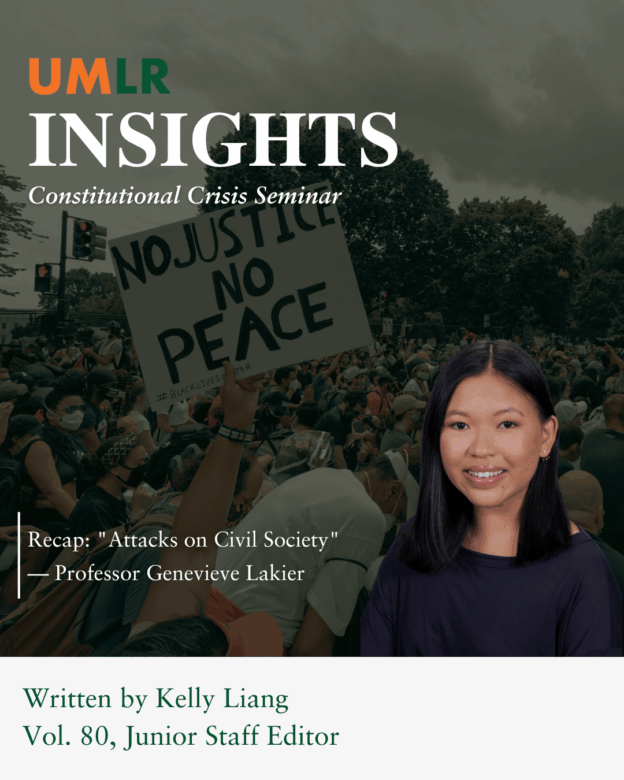
KELLY LIANG—Professor Genevieve Lakier of the University of Chicago Law School explores the Trump administration’s attacks on civil society and what that means from a First Amendment perspective. Ultimately, Lakier calls attention to a broader concern: that the government’s aggressive intrusion into civil society is undermining American liberal democracy.
Defining Civil Society
Traditionally, civil society refers to nongovernmental organizations (NGOs) that operate independently from both the state and the market, such as universities, nonprofits, and advocacy groups. However, Lakier adopts a broader view: civil society includes entities that help promote the interests of the people and advance liberal democratic values. Under this definition, even for-profit organizations such as media outlets are considered part of civil society because they sustain the free exchange of ideas central to democracy.
Civil society occupies the important space between the government and the private individual. It is neither a purely private realm of individual life nor an arm of the state; rather, it acts as a buffer that protects individual autonomy from government overreach. Civil society represents pluralism in action—forums where people can organize, deliberate, and act collectively. It provides alternative spaces where citizens can turn when they disagree with governmental policy. In moments of political instability or authoritarian creep, it functions as a stabilizing counterweight by resisting pressure to conform to whichever ideological project the current administration seeks to implement.
Tensions in the Civil Society Framework
Lakier identifies two major sources of tension that complicate civil society’s independence: government regulation and government funding.
First, because civil society organizations can wield significant power, the government often regulates them to check their power and maintain its role as the ultimate guarantor of public welfare and safety. Yet, this oversight undermines the ideal of separation between public and private spheres.
Second, many civil society organizations depend heavily on government funds, especially those providing services that do not operate according to pure market logic, such as education, healthcare, or public broadcasting. While funding helps sustain these organizations, it also gives the government leverage over their missions, priorities, and speech.
The result is a thorny situation: civil society in the United States cannot remain fully independent from the state, yet its legitimacy depends on maintaining some degree of autonomy.
The First Amendment & Civil Society
Historically, the Free Speech Clause of the First Amendment has served as a constitutional safeguard mediating the tension between governmental power and civil society’s independence. Free speech doctrine recognizes a boundary between government speech and private speech: the government may express its own viewpoints freely, but it cannot suppress or compel the speech of private actors.
Lakier argues that the Trump administration is chipping away at this principle. Rather than respecting the boundary between governmental and private expression, it has imposed its ideological beliefs—about gender, diversity, patriotism, and so forth—onto the organizations it funds or regulates. For instance, the administration’s assertion that there are only two biological genders was not merely presented as a governmental viewpoint; it was enforced as a condition for continued funding of universities and the scientific research organizations. Such arguably coercive conditions threaten broader First Amendment principles and civil society’s independence by requiring ideological compliance as the price of participation.
Executive Power & Control Mechanisms
Lakier acknowledges that this problem is not entirely new. Previous administrations have also expanded executive power through federal funding and regulation. For example, the Obama administration used Title IX enforcement to essentially compel universities to adopt new sexual assault procedures under threat of losing access to federal funds. What differs today is the scale and aggressiveness of these tactics. The Trump administration’s interventions represent a drastic escalation: an attempt not merely to regulate behavior but to reshape the ideological landscape of civil society itself.
Lakier identifies regulation and spending power as the two mechanisms the federal government under the Trump administration has used to undermine civil society. First, the administration has used discretionary regulatory powers—such as broadcast licensing and federal investigations—to punish dissenting voices. For instance, ABC pulled Jimmy Kimmel from its stations after the FCC threatened regulatory action for comments Kimmel made about the assassination of Charlie Kirk. Second, by conditioning federal funding on ideological compliance, the administration has coerced organizations into conformity. Because this administration’s approach to implementing its policies is bolder and more confrontational, organizations reliant on federal grants face an immense, unprecedented pressure to align their policies and speech with government preferences for fear of losing essential funding.
The Present Outlook
Lakier focuses on universities, law firms, and media organizations to exemplify how civil society’s independence is being eroded.
Universities have faced newfound, extensive government pressure. The administration has threatened to open Title VI or Title IX investigations against universities that fail to suppress certain kinds of student activism—such as student protests over the Israel-Gaza war—effectively dictating campus policies. Federal directives have also sought to eliminate diversity, equity, and inclusion (DEI) initiatives and reorganize academic departments—an attempt to control knowledge production and restrict critical thinking.
The administration has also exerted pressure on law firms by threatening to withhold government contracts, security clearances, or personnel. Firms have been warned against representing clients or filing suits that challenge government actions, weakening the legal profession’s capacity to hold government power accountable.
Similarly, media outlets have faced intimidation through regulatory agencies like the FCC, including threats of license revocation and targeted scrutiny. These tactics jeopardize press independence and chill investigative reporting.
Together, these examples reveal a broad pattern: the use of federal power to enforce ideological conformity and suppress dissent within civil society.
Why It Matters & Moving Ahead
The erosion of civil society’s independence strikes at the foundation of democracy. If universities, law firms, and the press cannot operate freely from government coercion, then citizens lose the organizations that enable them to question, check, and critique political authority.
Lakier warns that although these organizations formally retain First Amendment rights to challenge the government, their reliance on government funding and regulatory approval makes them hesitant to resist the administration’s efforts. In many instances, the organizations have capitulated to the administration’s demands. Law firms made deals, and universities changed policies. The result is a chilling effect: even without overt censorship, fear of retribution leads to self-censorship and compliance. The First Amendment, one of our most important constitutional safeguards designed to preserve the separation between public and private spheres, is no longer functioning effectively in the face of an aggressive executive branch and dysfunctional Congress.
Looking forward, Lakier says libertarianism, which supports complete government noninterference, is not the answer because government support remains essential for many public goods. She poses a challenge to future lawyers: how can we design legal and institutional safeguards that prevent the abuse of power? The challenge lies in imagining how the entanglements between civil society and government can present opportunities where pluralism and dissent flourish rather than vulnerable moments that lead to democracy’s demise. Lakier leaves us with a final question: with civil society under attack and constitutional safeguards faltering, what are “We the People” to do?
Visit the Seminar Main Series Page here.
Watch the episode here.


